Research on Useful-Life Estimates
Good news for those who love to nerd out over financial reporting rules or obsess over the financial disclosures of AI hyperscales: Calcbench has transcended both subjects with a new research report on “useful-life estimates” and how those numbers affect net income.
The useful-life estimate is one of those obscure disclosures buried away in the footnotes. As the name implies, it is management’s estimate of how long an asset (typically a physical asset such as a building, a vehicle, or a computer) will have a useful life before that asset becomes obsolete.
That estimate is important because the longer an asset’s useful life is, the more you can allocate the deprecation costs of the asset across that estimated lifespan:
The shorter the estimated useful life is, the higher the depreciation costs in any given period will be, because those costs are allocated across fewer years. That leads to lower net income for the period.
The longer the estimated useful life is, the lower the deprecation costs will be in any given period, because the costs are spread across more years. That leads to higher net income for the period.
Any time management changes the estimated useful life, by definition that will have a knock-on effect to net income. So how often do these changes happen, and what effect do they have?
That’s what our latest Calcbench research paper attempts to answer. You can download a PDF version from our research page; but because we love this stuff, we’ll share a few key insights here too.
What We Did, and Found
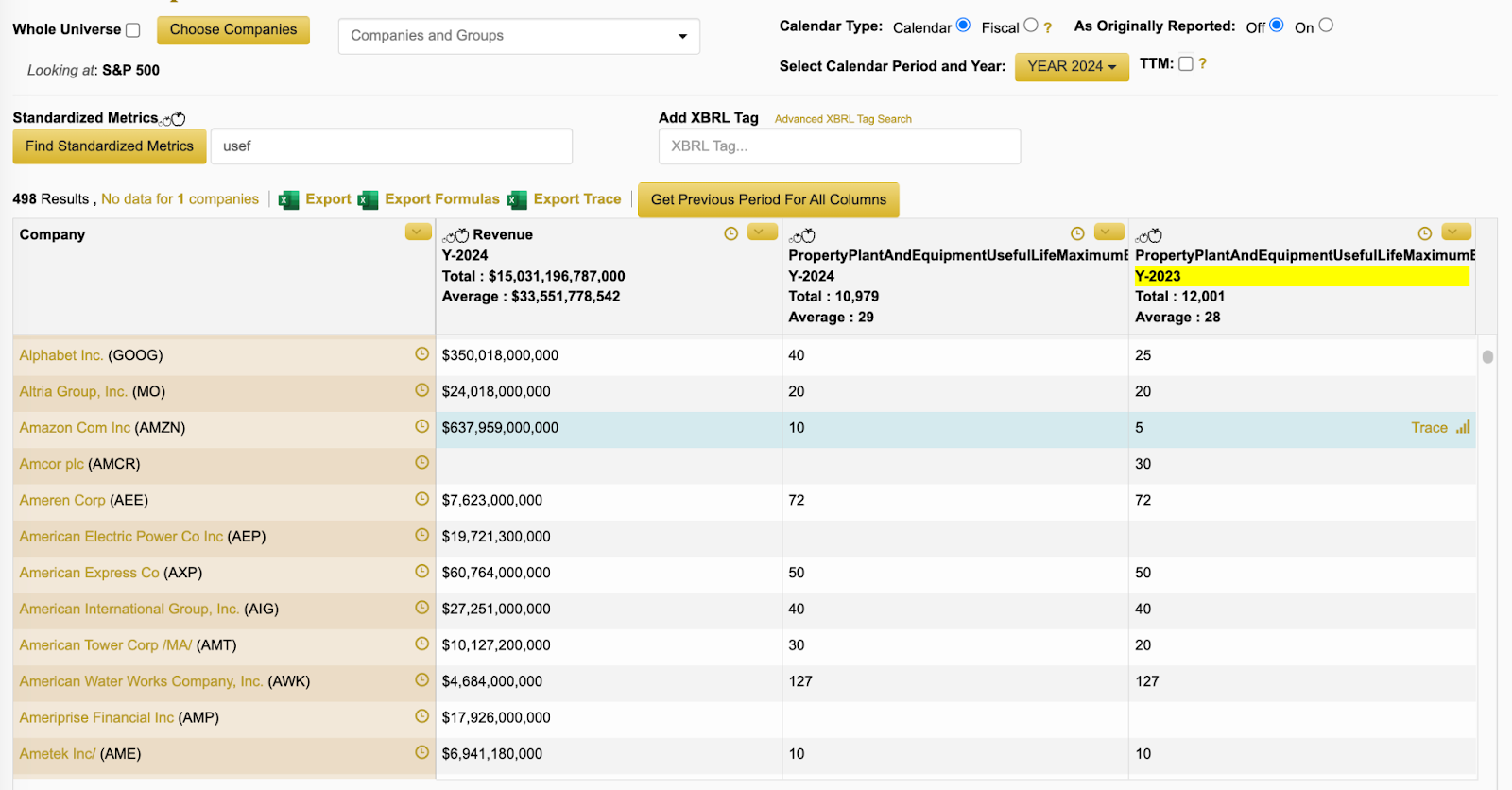
Calcbench examined every useful-life value that S&P 500 companies tagged in their financial statements for 2024 and 2025, to identify all instances where a company changed that useful-life estimate. Then we worked backwards to determine when those changes were first disclosed to investors. (We did exclude utility companies from our analysis, since they change estimates more often and are an outlier industry.)
Big conclusions from that aggregate analysis…
Changes to useful life are relatively rare. Of the 2,679 useful-life disclosures we found in 2024 filings, 2,500 of them (that is, 93 percent) remained unchanged in 2025. Among those disclosures that did change, we identified more that had extended useful-life estimates than shortened them, 44 versus 25.
Changes that did happen were often subtle. Some businesses didn’t extend the useful life of an estimate per se; they simply went from a specific estimate (say, five years) to an estimated range (five to seven years). Others kept the useful-life estimate but renamed the “axis” of the disclosure, analogous to moving an asset from one line-item to another while keeping its overall value
Changes often emerged during interim reports, not just annual reports. That is, when we found that a useful-life estimate had changed from 2024 to 2025 annual reports, we typically found the disclosure first happened in some 10-Q report between those two annual filings.
The AI Hyperscalers
After that aggregate analysis, we examined the disclosures of three AI hyperscalers: Alphabet ($GOOG), Amazon ($AMZN), and Meta ($META), to determine how each one determined the estimated useful life of its computer servers.
This was a fascinating exercise because (a) all three companies use so many servers that a change in estimated life can lead to a material change to net income; and (b) each hyperscaler has taken a different approach to estimated useful life of its servers, even though it’s the same equipment and all three are in the same line of work.
That is, Amazon shortened the life estimates of its servers, from six years to five. Meanwhile, Meta extended the estimated life, from four years to five or 5.5; and Alphabet didn’t change its estimates at all.
Wording, disclosure, and effect are all different for each company. See Figure 1, below, shamelessly stolen from our research report:

From there, you can see more about the new estimates’ effect on net income, what the changes say about management’s judgment on IT asset cost, and more.
We won’t give away the rest of the story since it’s all in the research note, but you can give it a download and see how you can sniff out these subtle, significant disclosure updates yourself!
Comments
Post a Comment