Posts

Showing posts with the label fundamentaldata

Revenue Performance Obligations: Q3 2025 vs Q3 2024

Image
Revenue Performance Obligations (RPO) represent the value of contracted revenue that a company has committed to deliver in future periods under existing customer agreements. RPO includes both short-term and long-term contractual commitments and reflects the remaining value of signed arrangements that have not yet been recognized as revenue. It provides a measure of future revenue that is already contractually secured. Across the S&P 500 companies included in this review, 151 firms reported RPO in both Q3 2025 and Q3 2024, and the median year-over-year change among those firms was an increase of 11.6%. One challenge with RPO disclosures is that companies place this information in widely varied locations within their filings — making it difficult for investors or analysts to retrieve consistently without a structured database. For example:  - Boeing includes RPO inside a paragraph titled “Backlog” within its segment and revenue disclosure.  - Microsoft reports it in ...
The Wealth of Standardized Data in Calcbench

Image
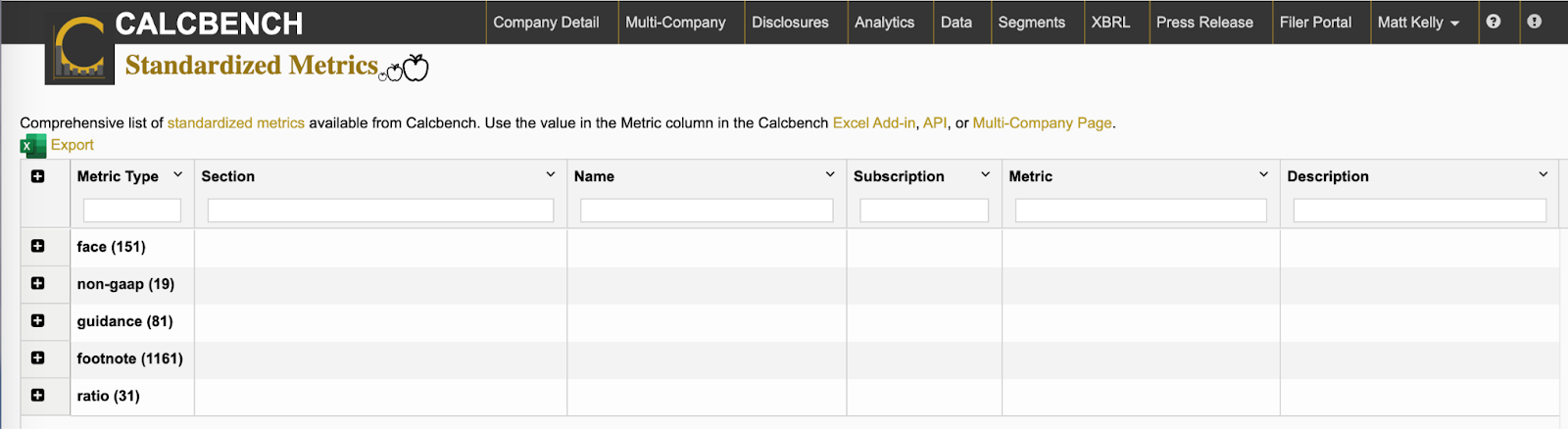
Calcbench offers a huge amount of data to our subscribers, and sometimes that’s all a subscriber wants — reams and reams of historical data, that you can use to populate your own models and analytical tools.  Today we wanted to give curious readers a quick look at how that works. The place to start is our Standardized Metrics page .  This page lists all the specific pieces of financial data that Calcbench tracks: nearly 1,500 items, from universally known disclosures reported by everyone on the primary financial statements, to some truly obscure stuff disclosed by a relative few companies, only in the footnotes.  When you first arrive at the Standardized Metrics page, you’ll see something like Figure 1, below. From there you can expand the menu for each of those five categories of data, to see a brief description of each data item we track. See Figure 2, which shows some of the non-GAAP disclosures we track.  From there you can select or de-select the specific data ...