Posts

Showing posts with the label inflation

A Taste of Restaurant Inflation Pressures

Image
Calcbench was feeling a bit peckish this week for insights into the macro-economic environment, so how better to pass the time then sifting through the earnings releases from restaurants to see what they had to say about inflation?  Various restaurant chains offer inflation forecasts as part of their earnings guidance. A good example of this is Darden Restaurants ($DRI). Last summer, at the end of its fiscal 2025, the company had forecast inflation for its upcoming fiscal year at 2.5 to 3 percent. By the end of its fiscal Q1 2026 in September, Darden nudged the forecast upward to 3 to 3.5 percent. Darden filed its latest earnings release this week, for its fiscal Q3 2026. It now forecasts inflation at 3.5 percent .  That led us to look for other disclosures at other restaurants. Sure enough, we found them. Texas Roadhouse ($TXRH) included inflation estimates in its 2025 full-year earnings release filed on Feb. 19. The company predicts wage and labor inflation costs of 3 to...

Inflation Insights in the Restaurant Sector

Image
This week the U.S. government released its latest inflation figures, and while the headline was that inflation overall decelerated to 2.7 percent , the sub-category of food eaten outside the home — that is, food eaten at restaurants — popped upward by 3.7 percent.  As fate would have it, Darden Restaurants ($DRI) just reported its latest earnings release too — complete with an estimation of inflation for the coming year! So let’s see what Darden disclosed and what other clues about dining out costs one might be able to find by poking around restaurants’ disclosures. First, Darden’s estimate. The company provided a forward-looking estimate of 3.5 percent inflation for its fiscal 2026 (which is already half over) among various other outlook numbers. See Figure 1, below. Notice that the 3.5 percent number is tagged; so using our ‘See Tag History’ feature, we pulled up Darden’s prior estimates for annual inflation going back to 2018. See Figure 2, below. Those numbers kinda sorta ali...

Darden Restaurants Serves Up Inflation Warning

Image
Casual dining player Darden Restaurants ($DRI) filed its latest earnings release today — and if you looked closely at the data, you could see the risk of inflation peeping out through the numbers.  For starters, in the earnings release that Darden filed for its quarter that ended Aug. 25, the company flat-out said it expects inflation for the coming fiscal year to be 3 to 3.5 percent. That was the only actual mention of the word in the earnings release, but with a few quick keystrokes we found a more complete picture. First, we used our Disclosures and Footnotes Query page to pull up the precise guidance Darden included in its earnings release for this quarter, its fiscal Q1 2026. That guidance, published on Sept. 18, said Darden expects inflation in the range of 3.0 to 3.5 percent for the coming fiscal year.  Then we punched the Previous Period tab to compare this quarter’s guidance to what Darden said in its prior quarter. Turns out that just three months ago, Darden was ...

Charticle - SG and A Costs

Image
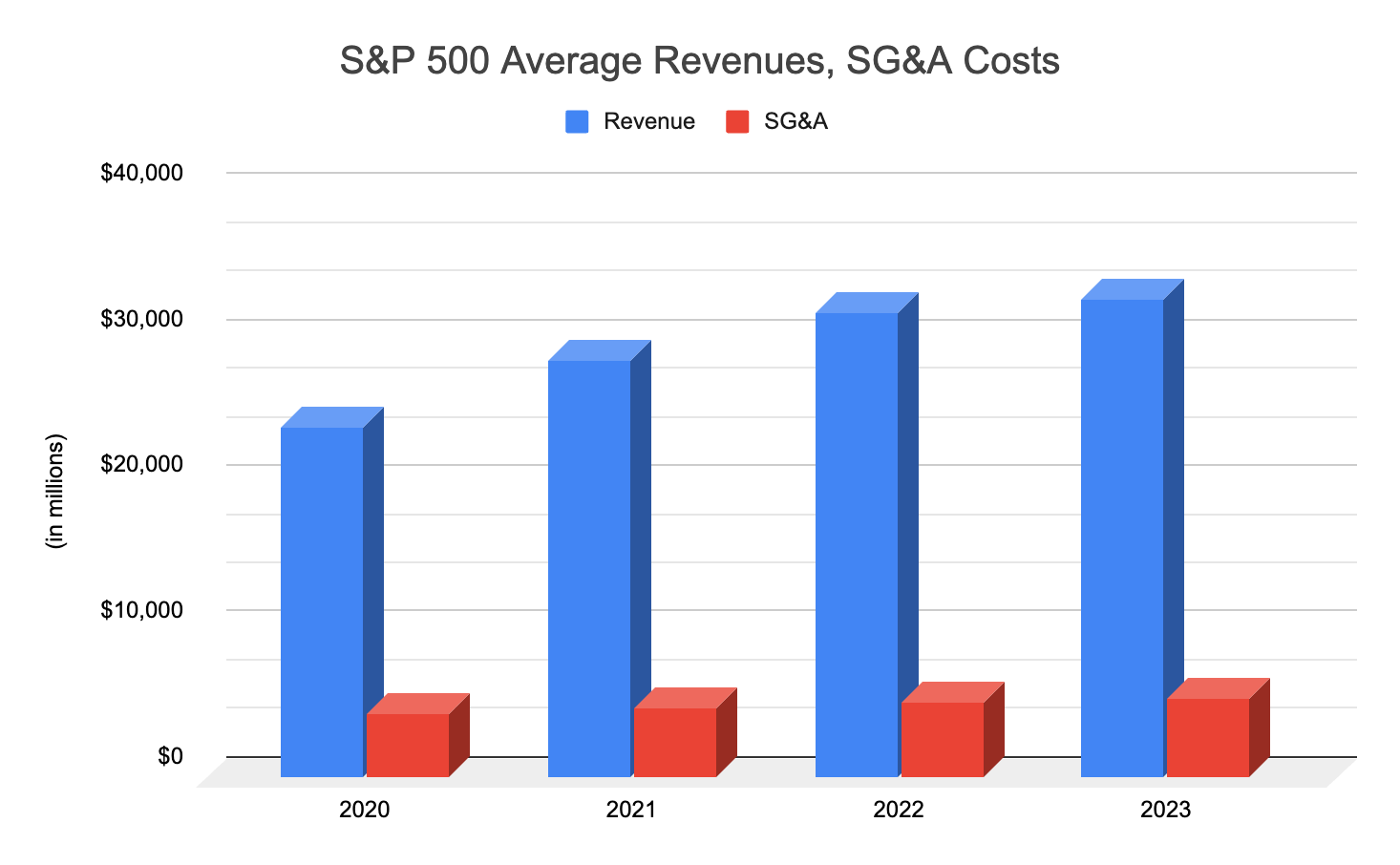
Economic headlines might say that inflation is a fading concern, but the Calcbench analytics team still likes to check on telling indicators of inflationary pressure from time to time. Today let’s take a look at SG&A costs. SG&A stands for “sales, general, and administrative” costs, and encompasses pretty much any cost not directly related to making a product or delivering a service. Marketing, shipping, utilities, rent, coffee in the breakroom, ficus trees in the lobby — all of that, and more, rolls into SG&A costs. We were curious about two questions. First, how much have SG&A costs risen for the S&P 500 in the last several years? Second and more important, how much have those costs risen as a percentage of revenue?  The first is easy. Using our Bulk Data Query tool , we pulled quarterly SG&A costs for the S&P 500 from the start of 2020 through second-quarter 2024. In total those costs rose 21.6 percent , from $482.9 billion to $587.3 billion. Average ...