Public Companies Have Disclosed $18.7B in Tariff Refunds
Figures reflect filings and disclosures identified as of August 28, 2026.
Following the invalidation of tariffs imposed under the International Emergency Economic Powers Act (IEEPA) earlier this year, public companies have begun reporting significant tariff refunds, expected recoveries, approved claims and refund receivables.
Calcbench has identified approximately $18.7 billion of gross tariff refunds across 101 public companies . The 11 largest company-specific amounts identified so far account for approximately $12.1 billion of the total, and they’re listed in the table below. (Normally we would do a top 10 list, but UPS and General Motors are tied at $500 million each, so we are treating the group as 11 rather than cutting them off at 10.)
| Company | Ticker | Gross refund or recovery | How disclosed |
|---|---|---|---|
| Walmart | WMT | $2.9 billion**** | Spoken disclosure (Q2 FY27 earnings call) |
| Apple | AAPL | $2.19 billion* | Narrative and earnings disclosure |
| Ford Motor | F | $1.30 billion | Narrative disclosure |
| Target | TGT | $994 million | Narrative disclosure (MD&A operating metrics footnote) |
| Nike | NKE | $986 million | Company-specific XBRL extension |
| FedEx | FDX | $800 million | Company-specific XBRL extension |
| Home Depot | HD | $730 million | Narrative disclosure |
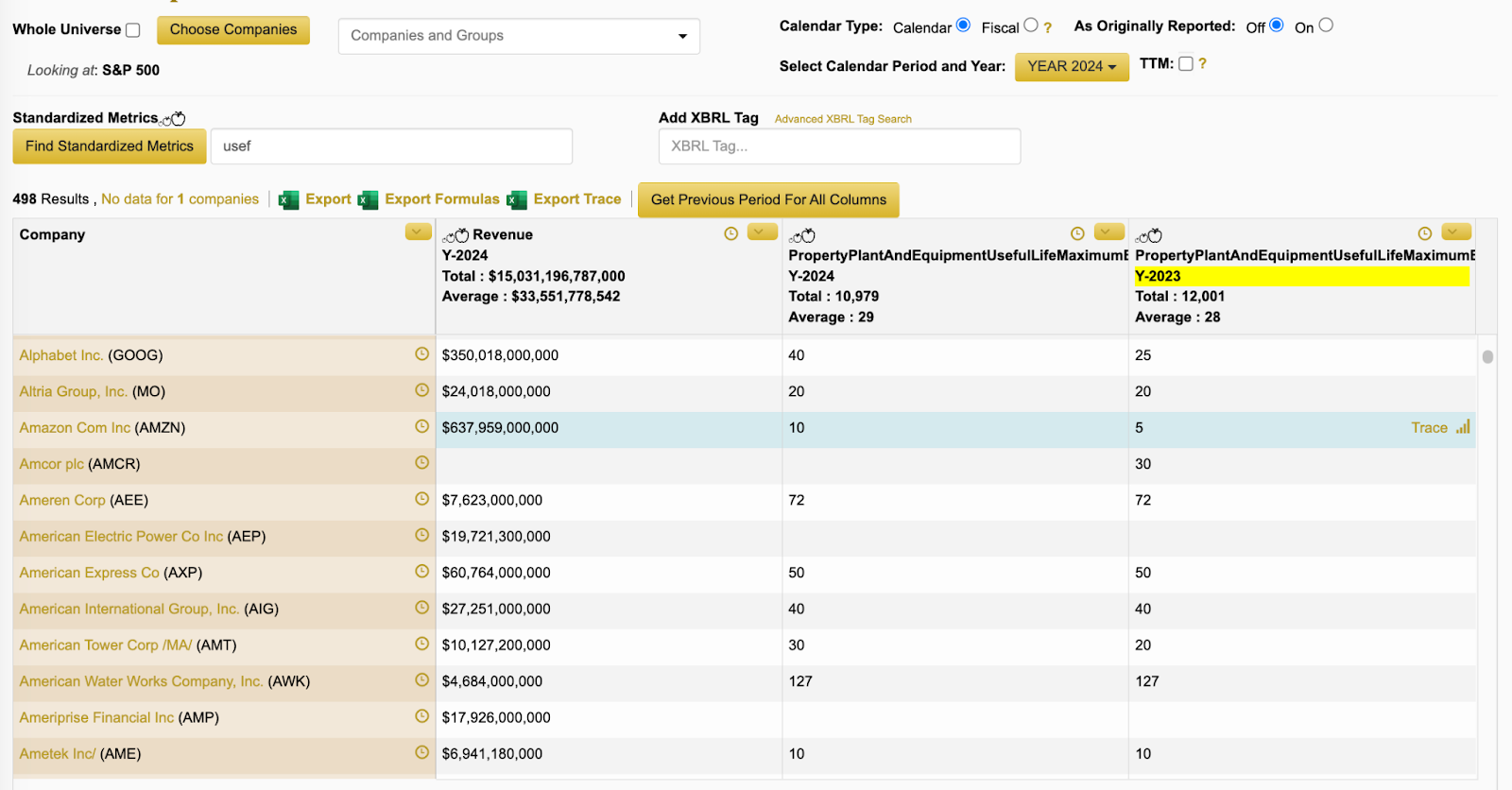
| Amazon | AMZN | $640 million | FASB-taxonomy XBRL fact and dimension |
| The Gap | GAP | $512 million | Narrative disclosure |
| UPS | UPS | $500 million | Company-specific XBRL extension |
| General Motors | GM | $500 million** | Narrative disclosure |
The distribution is notably top-heavy. The 11 companies in the table above represent roughly 65 percent of the $18.7 billion we’ve identified across the whole 101 firms in our sample group; and the five largest account for 45 percent.
That concentration rhymes with a broader pattern visible across many parts of today’s marketplace: a relatively small number of very large companies often account for a disproportionate share of the aggregate dollars.

* Apple's tariff-refund impact was disclosed in its fiscal Q3 2026 earnings press release, not in the 10-Q. The company reported quarterly revenue of $109.4 billion and gross margin of 50.1%, including a favorable impact of approximately two percentage points from tariff refunds, and diluted EPS of $2.02, including a $0.11 favorable impact from tariff refunds. Applying the gross-margin effect to quarterly revenue produces an estimated gross recovery of approximately $2.19 billion; we did not rely on the EPS impact and share count, which would produce a similar but not identical estimate.
** General Motors described a net $0.5 billion favorable adjustment primarily attributable to previously charged, refundable IEEPA tariffs. We use that amount as the best disclosed estimate rather than treating it as a separately reported cash receipt. GM separately disclosed an estimated $2.5–3.5 billion full-year EBIT-adjusted impact from the broader tariff environment; that figure is a forward-looking net cost estimate covering largely non-IEEPA tariffs and is unrelated to the refund pool measured here. Masco disclosed a similar net-only figure: approximately $95 million of net tariff benefit, principally in its Plumbing Products segment, for both the three and six months ended June 30, 2026 (indicating the full amount was recognized in the second quarter). As with GM, no separate gross or total-paid figure was disclosed alongside it. Dollar General took this a step further, disclosing only basis-point impacts directly (81 basis points to gross margin, 66 basis points to operating margin, both explicitly "after related reinvestments") and a $0.25 per-share EPS benefit, with no dollar figure anywhere in its release. We estimated approximately $55.5 million by backing into implied diluted shares from disclosed net income and EPS ($550.3 million ÷ $2.48 ≈ 221.9 million shares) and applying the per-share benefit — a derived, net-of-reinvestment, after-tax estimate, not a company-disclosed figure.
Why these refunds are difficult to find
Among the 11 largest recoveries, narrative-only disclosure accounts for 52 percent of the dollar amounts. Company-specific XBRL extension tags account for for 19 percent, and standard FASB-taxonomy tags for 5 percent.
The remaining 24 percent — the single largest dollar amount in this group — was disclosed only verbally, on Walmart's earnings call, and does not yet appear in any SEC filing. A search of the standard FASB XBRL taxonomy alone would miss the large majority of the money sitting in just the largest recoveries. Companies have used at least four different disclosure approaches:

-
Standard FASB taxonomy tags and dimensions.
Amazon and a number of other companies reported refund amounts using a standard tag such as
RecoveryOfDirectCosts, combined with an IEEPA tariff-refund dimension. -
Company-specific XBRL extension tags.
Nike used
InternationalEmergencyEconomicPowersActExpectedRecoveryOfTariffsPaid. FedEx usedProceedsFromInternationalEmergencyEconomicPowersActTariffs. UPS usedIEEPATariffRefundClaimsSubmitted. - Narrative or earnings disclosures. Apple, Ford, Target and General Motors disclosed material amounts without a directly usable numeric XBRL fact identifying the refund.
- Spoken commentary only, with no numeric disclosure in any filing. Walmart's CFO stated on the company's Q2 FY27 earnings call that Walmart "was eligible for approximately $2.9 billion of tariff refunds, amounting to approximately 0.5% of our annual U.S. net sales," and that "to date, we have received substantially all of these tariff refunds." At the time of this analysis, that figure does not appear in Walmart's earnings release, its 37-page investor presentation, or any SEC filing — only in the recording of the call itself.
- Disclosed only inside a non-GAAP reconciliation table. Boston Scientific's $83 million IEEPA tariff refund appears exclusively as a line item in its Q2 2026 non-GAAP earnings reconciliation exhibit, treated as a one-time add-back excluded from adjusted results in the same manner as restructuring or litigation charges. Fortive followed the identical pattern at a smaller scale: its 10-Q risk-factor language confirmed that refund claims were being submitted and approved amounts recognized within cost of sales, but disclosed no figure there; the $4.5 million pretax amount appeared only in the separate earnings release's non-GAAP reconciliation. Motorola Solutions disclosed its $60 million pretax benefit ($0.25 per share) the same way, in a single reconciliation footnote within its earnings release. Urban Outfitters followed the same pattern with a $95.66 million figure, shown using the standard parenthetical-negative convention as an add-back subtracted from GAAP results to arrive at adjusted figures.
- Acknowledged but never quantified. First Solar disclosed that receivables for outstanding IEEPA refund claims as of June 30, 2026 were included within "Other current assets," a balance sheet line that totaled $741.4 million as of June 30, 2026 (up from $643.1 million at December 31, 2025) — but the company never isolated what portion of that total, or its increase, related to tariff refunds specifically. We could not extract a comparable figure and have not included First Solar in the totals above.
- Quantified, but recognized as zero. Deckers Outdoor disclosed a total gross amount of tariffs paid of approximately $120,000 — immaterial at this analysis's scale — and stated explicitly that it had recognized none of it as of the filing date, applying a gain contingency model under ASC 450 and noting that cost-sharing arrangements with its independent manufacturers may mean its own net exposure is smaller than the gross figure regardless. Not included in the totals above.
Caterpillar is an especially useful example, even though its $392 million recovery has since fallen just outside this top group. It tagged the recovery as
ReceivableForRecoveryOfImportDutiesNet. The tag itself does not mention IEEPA or tariffs. The accompanying text explains that the amount represents expected IEEPA recoveries for claims submitted and accepted through the government's CAPE system.
Caterpillar also disclosed that its total IEEPA tariff costs since the tariffs took effect were approximately $1 billion — meaning roughly $600 million of its own paid tariffs ae not yet reflected in any refund total, ours included, pending further CAPE claim submissions and approvals.
Capri Holdings pushed the same problem further; it accounted for its $65 million IEEPA tariff refund receivable under ASC 410-30, Environmental Obligations — an accounting standard written for environmental remediation, applied here by analogy — which means its XBRL facts are tagged using environmental-remediation elements with an IEEPA dimension attached. A search for tariff-specific or import-duty-specific tags would never surface it.
Company-specific totals require review
The facts also cannot simply be added together to give you a clear sense of tariff refunds. A company may disclose a consolidated recovery, business-segment components, cash received to date, a remaining receivable and a related liability; adding them all together could lead you down a wildly inaccurate path.
Nike, for example, reported a consolidated recovery of $986 million, disclosed in Note 1, Summary of Significant Accounting Policies of its 10-K filed July 15, 2026. It also reported $965 million for North America, $21 million for Converse and $302 million of proceeds received. The $965 million and $21 million are components of the $986 million total, while the $302 million is a cash-receipt subset. Adding all four observations would substantially overstate Nike's recovery.
UPS provides another example. Its disclosure reported approximately $500 million of approved Phase 1 claims, consisting of $200 million received and $300 million recorded as a receivable. The correct company-level amount is $500 million, not $1 billion — but if you added all three items together, $1 billion is what you’d get.
Resideo Technologies and ADI Global Distribution present a third, structurally different version of the same trap. Resideo recognized approximately $27 million of IEEPA tariff refunds in its consolidated Q2 2026 results. ADI Global Distribution — Resideo's sole operating segment prior to its August 2026 spin-off — separately disclosed approximately $20 million of IEEPA refunds in its own pre-spin-off combined financial statements, covering the same period during which ADI was still wholly owned by Resideo.
The $20 million is almost certainly a subset of Resideo's $27 million, not an additional amount; we count only Resideo's consolidated figure. A spin-off's carve-out financial statements can create the same kind of overlap as a company's own internal segment reporting, just across two separate SEC filers rather than within one.
What the $18.7 billion represents
For this first stage of the analysis, Calcbench is measuring the gross tariff-refund pool. The total includes disclosed refunds, expected recoveries, approved claims, refund receivables and clearly identified eligible amounts.
Where a company discloses both a cash-received amount and a separately recognized receivable for the remainder, we use the cash-received figure only, not the combined total.
LCI Industries, for example, disclosed $94.9 million actually received alongside a separate $24.4 million receivable deemed probable but not yet collected; we use $94.9 million. Xylem disclosed $4 million received and a separate $12 million receivable; we use $4 million.
This is a deliberate choice, and not the only defensible one; a reasonable rationale exists for using the full recognized total instead, since a receivable deemed probable under U.S. GAAP is not a speculative number.
We chose the more conservative figure for consistency across companies with very different disclosure structures. Where a company discloses only a single recognized amount with no cash-received breakout at all — Solventum and McCormick among them — that total is the only figure available and is used as-is.
Zimmer Biomet is a clean example of this: it states it "received a portion" of its $77 million in previously paid tariffs during the second quarter but never quantifies that portion separately, so the full $77 million recognized under its loss recovery accounting model is the figure used here. Calcbench's underlying data captures both the cash-received and total-recognized figures wherever a company discloses the split, so a reader who prefers the alternative convention can reconstruct it directly from the same source data.
One further caveat applies to a single company: International Flavors & Fragrances disclosed $18 million of tariff refunds received, but explicitly net of amounts expected to be remitted to customers — the only entry in this analysis where the figure itself is already net rather than gross, with neither the gross amount received nor the size of the customer obligation being netted out separately disclosed. We include it at $18 million since no other figure is available, but it is not strictly comparable on a gross basis to every other company in this table.
We have not yet reduced the amounts for obligations to return refunds to customers or share them with suppliers, and the size of that reduction varies enormously by company. Target and Amazon, by contrast, disclosed no customer-refund liability at all — both recognized their refunds as a direct reduction of Cost of Sales with no stated pass-through obligation, implying the full amount was retained.
FedEx received approximately $800 million and separately reported a $749 million customer-refund liability, leaving roughly $51 million retained net — about 6 percent of the gross figure. Medline's $332 million recovery carried an $89 million estimated customer-repayment accrual, implying roughly $243 million retained net, or about 73 percent. Cardinal Health's $200 million receivable produced a disclosed net operating-earnings benefit of approximately $100 million for the quarter, or roughly 50 percent retained, once its own customer repayment obligation is factored in.
UPS's situation is structurally different from the other three. UPS describes itself as acting as an intermediary for cross-border shipments, at times paying tariffs on behalf of customers and passing those costs through under its contract terms. It recorded the full $500 million of CBP-approved refunds within Other current liabilities rather than as a straightforward asset, and has disclosed no dollar figure for what portion, if any, it expects to retain once entries are reconciled and refunds are passed through. That makes UPS's $500 million harder to compare directly to FedEx's, Medline's, or Cardinal Health's gross figures, which represent tariffs those companies paid on their own imported goods.
Walmart presents a fifth pattern: no customer-refund liability, but an explicit statement that the benefit is being funneled into price investments rather than kept as pure margin. Walmart's own earnings materials note that adjusted operating income growth in constant currency of approximately 17 percent included a 750-basis-point net benefit from tariff refunds received, after accounting for those price investments — implying a current-quarter net operating income effect of roughly $600 million, a much smaller number than the $2.9 billion cumulative refund figure disclosed on the call.
On Holding sits at the opposite extreme from Walmart. As of June 30, 2026, the Swiss footwear and apparel company had paid CHF 55.6 million in IEEPA tariffs and submitted CHF 52.7 million for refund processing, but recognized none of it — applying a "virtually certain" recognition threshold, stricter than the "probable" standard used by most companies in this analysis, and concluding that bar had not yet been met. By August 11, 2026, the company reported it had actually received approximately CHF 27.9 million, to be recognized in the third quarter.
Hubbell followed a similar pattern on a smaller scale: as of June 30, 2026, it had recognized nothing under its ASC 450-30 gain contingency model, but disclosed as a subsequent event that it had since received approximately $30 million in refunds. We count both On Holding's and Hubbell's actually-received amounts in the total, on the basis that real cash changing hands is a meaningful threshold even when formal accounting recognition lags behind it. Trimble adds a further variation: of its $17.8 million approved refund, it received $13.9 million in cash during the quarter, but structured its planned customer refunds as a reduction of revenue rather than a cost-side liability the way FedEx, Medline, and Cardinal Health did — the same underlying obligation to share the benefit with customers, booked on a different line of the income statement. Williams-Sonoma introduces a direction none of the others do: of its $197.8 million initial claim (all but $3.2 million collected as of August 2, 2026), $47.5 million was provisioned not for customers but to reimburse merchandise vendors who had previously extended the company tariff-related price concessions — benefit flowing upstream to suppliers rather than downstream to customers. Williams-Sonoma also directed $10.0 million of the refund toward a one-time discretionary 401(k) contribution for its employees, a voluntary use of the windfall rather than an accounting obligation of any kind. TJX went much further in the same direction: of its $331 million in gross refunds, it accrued $112 million of incremental incentive compensation and discretionary bonus expense for employees globally, netting to a $219 million pretax profit benefit — a formal accrued expense more than eleven times the size of Williams-Sonoma's, showing that directing refund proceeds to employees is a repeatable choice, not a single company's gesture. The Gap confirmed this is not a one-off: of its $512 million in gross tariff refunds, $95 million was committed to certain vendors as what the company called a "commitment of appreciation," netting to $417 million recognized in cost of goods sold. We include UPS's full $500 million and Walmart's full $2.9 billion in the $18.7 billion gross pool, consistent with how every other company's gross figure is treated, but readers should not assume either company retains anything close to its full disclosed amount.
****** On Holding reports in Swiss francs. We converted its approximately CHF 27.9 million received to approximately $34.3 million using an approximate CHF/USD exchange rate of 1.23 for the relevant period; we did not attempt to pin down the exact daily rate, since the currency effect at this size is immaterial to the totals in this analysis. On Holding's disclosure is, to our knowledge, the most conservative recognition posture of any company covered here: despite CHF 55.6 million paid and CHF 52.7 million already submitted for processing, none of it had been recognized in the financial statements as of June 30, 2026.

The immediate task is to identify and ringfence the gross refund population. Based on disclosures identified so far, that population totals approximately $18.7 billion across 101 public companies . The figure is a moving target in the most literal sense: Target and Lowe's each disclosed material IEEPA tariff refund impacts after this analysis was first compiled, adding a combined $1.08 billion and pushing Target directly into the top three; Walmart then disclosed, verbally, an amount larger than any other company's, adding a further $2.9 billion and taking the top spot outright. Target recognized $994 million as a reduction of Cost of Sales for the quarter and six months ended August 1, 2026, with no disclosed customer pass-through obligation. Lowe's disclosed a $0.11 per-share benefit to diluted and adjusted diluted EPS; applied to approximately 560 million diluted shares, that implies an after-tax impact of roughly $61.6 million, or approximately $81 million on a pre-tax basis grossed up at Lowe's approximate 24% effective tax rate.*** Caterpillar, separately, has disclosed roughly $600 million of its own paid IEEPA tariffs that are not yet reflected in any recovery figure, pending further CAPE claim submissions and approvals, and Cardinal Health noted that the majority of its refund requests fall under CBP's Phase 2 process, launched only in June 2026, with additional phases still to come. Taken together, these are concrete examples of a broader dynamic: CBP's refund process is still working through its early phases, and the total measured here reflects what has been recognized to date, not the full population of IEEPA tariffs eventually expected to be refunded. John Deere, reported separately, disclosed tariff recoveries of $110 million in its third fiscal quarter and $382 million for the first nine months of fiscal 2026 , embedded within its segment-level Production Costs reporting rather than called out as a standalone line — a reminder that some of the more generic "tariff recoveries" language in segment disclosures may be easy to overlook even when a specific dollar figure is present.*****
***** Deere's Q3 FY2026 disclosure does not use the term IEEPA and does not cite the Supreme Court ruling directly. We include it in this analysis on the basis of Deere's own fiscal 2025 Form 10-K, filed in late 2025, which stated: "On November 5, 2025, the United States Supreme Court heard oral arguments on tariffs imposed under the International Emergency Economic Powers Act (IEEPA). The court may provide tariff relief and the potential recovery of amounts previously paid. We are monitoring developments in this case and its impact on our future financial statements and business." Deere's subsequent "tariff recoveries" language, appearing in the first fiscal quarter after the ruling, is treated here as referring to that same IEEPA matter, though the Q3 disclosure itself does not make the connection explicit.
Advance Auto Parts, by contrast, disclosed a small but explicitly labeled figure: $26 million of second-quarter 2026 adjusted gross profit tied specifically to refunds of tariffs previously paid under IEEPA , with the company noting that the rest of its gross margin improvement was driven by unrelated merchandising initiatives. Unlike Deere's ambiguous phrasing, there is no inference required here — a useful reminder that disclosure quality varies as much among smaller amounts as it does among the largest ones.
*** Lowe's disclosed a $0.11 per-share benefit rather than a direct dollar figure. Applied to approximately 560 million diluted shares outstanding, this implies an after-tax net income impact of approximately $61.6 million. Because diluted EPS is an after-tax measure, we grossed this up using Lowe's approximate 24% effective tax rate (23.9% per its most recent 10-K) to estimate a pre-tax/gross figure of approximately $81 million, for rough comparability with the gross figures reported elsewhere in this analysis. Unlike Apple's gross-margin-based estimate, this figure is derived from an after-tax EPS impact and a tax-rate assumption and should be treated as a rougher approximation. At approximately $81 million, Lowe's does not rank among the largest recoveries identified so far.
**** Walmart's $2.9 billion figure comes from its Q2 FY27 earnings call (Bentonville, Ark., August 20, 2026), where the company's CFO stated Walmart "was eligible for approximately $2.9 billion of tariff refunds, amounting to approximately 0.5% of our annual U.S. net sales," and that "to date, we have received substantially all of these tariff refunds." At the time of this analysis, that figure does not appear in Walmart's earnings release, investor presentation, or any SEC filing; we cite the recording of the call directly, at approximately the 23:40–23:54 mark. Separately, Walmart's investor presentation states that adjusted operating income growth in constant currency of approximately 17% for the quarter included a 750-basis-point net benefit from tariff refunds received, after accounting for offsetting price investments — a figure that implies a current-quarter net operating income effect of roughly $600 million, which is not directly comparable to the $2.9 billion cumulative eligibility figure disclosed on the call. We use $2.9 billion as Walmart's entry in this analysis for consistency with how every other company's cumulative gross figure is treated, while noting that it is currently the only figure in this dataset sourced entirely from spoken commentary rather than a written filing or press release.
The broader lesson: structured data is essential to this analysis, but relying on a single taxonomy tag is not sufficient. A complete result requires standard XBRL facts, company extensions, dimensions and narrative disclosure text to be analyzed together — and, as FedEx shows, the gross number is only half the story until the pass-through obligations are netted out.
Comments
Post a Comment